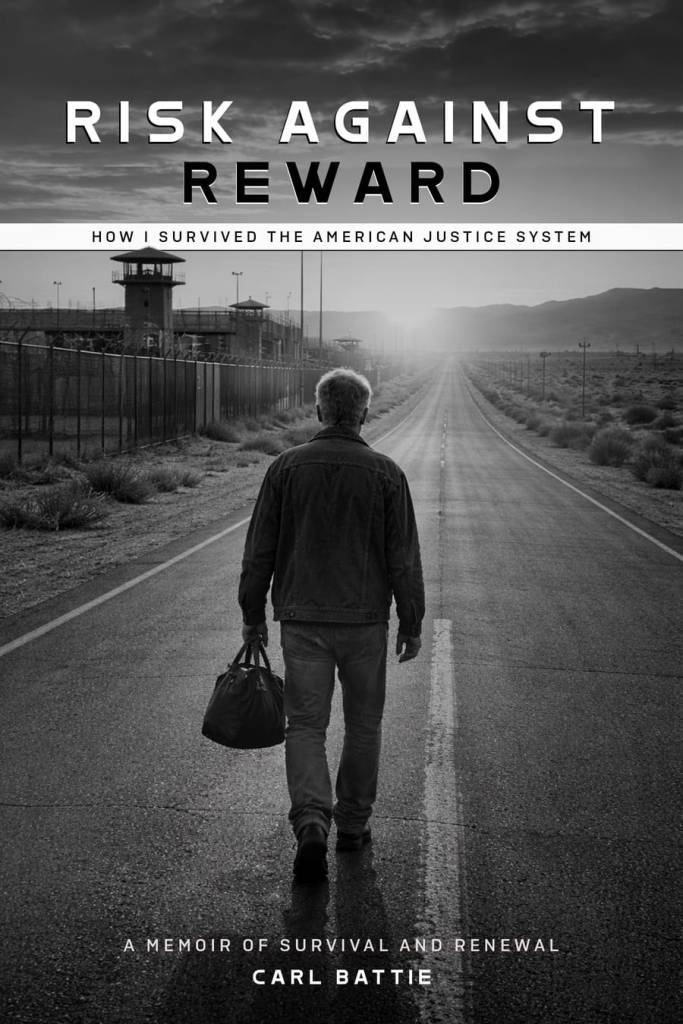
The True Cost of a Life Built on Calculated Risk
Carl Battie’s Risk Against Reward is a deeply unsettling and compelling memoir that takes readers far beyond the surface of crime and punishment. At its core, this book is not simply about fraud, wealth, or incarceration. It is about the dangerous psychology of choice, the seductive pull of reward, and the devastating consequences that can slowly accumulate over a lifetime.
Battie’s story begins not with excuses, but with stark honesty. He openly acknowledges that his criminal path was not born from poverty, abuse, or desperation. Raised by hardworking parents and later shaped by the discipline of military life, Battie had structure, resilience, and legitimate opportunity. Yet his memoir reveals how boredom, ambition, and an appetite for greater challenging rewards gradually pushed him toward increasingly dangerous choices.
This brutally honest foundation is what makes Risk Against Reward so effective. Rather than portraying crime as glamorous, Battie offers readers an intimate look at how intelligence, discipline, and opportunity can be dangerously redirected when personal gain begins to overshadow morality.
From Military Discipline to Criminal Ambition
Battie’s early life provides a fascinating contrast to the life he would later build.
Serving over four years in the British Army, including multiple tours in Northern Ireland, Battie developed discipline, structure, and strategic thinking. These qualities could have easily supported a conventional life. Instead, as he candidly reveals, his military background became part of the mindset that later shaped his criminal career.
Upon leaving the Army, Battie’s early ventures into black-market trading introduced him to a world where calculated risks produced rapid financial rewards. What began with relatively small illegal enterprises gradually evolved into increasingly sophisticated criminal operations.
Battie’s memoir carefully traces this progression, showing how black-market dealings transformed into financial fraud, banking schemes, and international real estate scams across England, Spain, Germany, and eventually the United States.
One of the book’s greatest strengths is Battie’s ability to explain the incremental nature of criminal escalation. His story demonstrates that criminal empires are rarely built overnight. Instead, they often emerge through a series of rationalized compromises, where each successful risk encourages even larger ones.
The Risk Versus Reward Mentality
Throughout the memoir, Battie repeatedly returns to the philosophy that defined much of his life: weighing risk against reward.
For decades, this mindset shaped his decisions. If the potential reward justified the perceived risk, he moved forward.
This formula allowed him to justify increasingly unethical behavior while maintaining a sense of strategic control. Battie’s financial success reinforced his belief that he could outmaneuver consequences indefinitely.
Yet Risk Against Reward powerfully reveals the flaw in this logic.
While Battie carefully calculated financial risks, he consistently underestimated the deeper personal costs:
- Family loss
- Emotional damage
- Physical deterioration
- Freedom
- Identity
This psychological framework transforms the memoir into far more than a crime narrative. It becomes a profound examination of how ambition and greed can distort rational thinking over time.
The Arrest: When the Illusion of Control Ends
Battie’s arrest in May 2014 is one of the memoir’s most gripping and cinematic moments, unfolding with the intensity of a crime thriller while carrying the devastating emotional weight of real life.
What began as an ordinary early morning at his home quickly descended into chaos. Battie was following his normal routine, enjoying coffee and the quiet comfort of his home, when everything changed in an instant. Armed FBI agents stormed his property, helicopters hovered overhead, and national media documented the dramatic scene as if it were a major criminal takedown broadcast for public spectacle.
For Battie, this was not merely an arrest. It was the sudden and humiliating collapse of a criminal life more than thirty years in the making.
At 56 years old, after decades spent building wealth through calculated deception across multiple countries, he was forced to confront the reality that the carefully controlled world he had created was finally over.
Battie’s reflections during this moment reveal a mixture of shock, fear, disbelief, and reluctant self-awareness. Beneath his outward composure, readers can sense the painful realization that karma had finally arrived.
This arrest marks a profound emotional shift within the memoir. For the first time, Battie is no longer the strategist calculating risk from a position of power. Instead, he becomes a man stripped of certainty, freedom, and status.
Inside the American Justice System: The Lost Decade
What follows is nearly ten years of incarceration, a period Battie painfully describes as his “lost decade.”
From the moment he enters prison, readers are confronted with the shocking transformation of a man who once controlled international scams into an inmate stripped of dignity, privacy, and identity. Battie vividly recounts the humiliation of invasive strip searches, the degrading intake procedures, and the harsh institutional systems designed to break individuality.
As he moves through county jails, detention centers, and some of America’s most notorious prisons, Battie faces an entirely different kind of survival challenge. Violence, racial divisions, prison politics, and the constant threat of danger become part of his daily reality. Every interaction carries risk, and even small mistakes can have serious consequences.
Beyond physical survival, Battie reveals the crushing emotional burden of incarceration. Isolation, loneliness, betrayal, and the realization that many of the people he once trusted had disappeared from his life created profound psychological strain. He describes prison not only as a physical confinement, but as a relentless mental battle against depression, fear, and emotional deterioration.
His reflections on prison life expose a deeply dehumanizing system where survival often depends on silence, observation, emotional suppression, and adaptation.
Rather than focusing on self-pity, Battie presents these experiences as the brutal consequences of his own choices. His years behind bars become a painful reckoning, forcing him to confront the true price of the life he had spent decades building.
Family, Health, and the Real Cost of Crime
While incarceration is central to Battie’s story, some of the memoir’s most heartbreaking moments involve the personal losses that extended beyond prison walls.
Battie’s criminal life ultimately cost him his marriage, distanced him from his children, and fractured the family life he once had.
These losses are particularly poignant because they reveal the true cost of his decisions. Financial wealth and criminal success proved temporary, but the damage to his relationships became one of the most painful consequences he faced.
As the years progressed, Battie also battled severe physical decline, including prostate cancer, kidney complications, and the emotional burden of aging within the prison system.
This combination of declining health, personal regret, and lost relationships transforms Risk Against Reward into something much deeper than memoir.
It becomes a cautionary reflection on the irreversible human cost of sustained moral compromise.
Writing Style: Direct, Reflective, and Unapologetically Honest
Battie’s writing style is conversational, vivid, and emotionally candid.
His straightforward storytelling makes complex criminal enterprises, legal battles, and prison experiences highly accessible to readers without losing emotional gravity.
Perhaps most importantly, Battie does not attempt to excuse his behavior.
He accepts responsibility for his actions while allowing readers to understand the psychological mechanisms that justified them at the time.
This honesty creates a memoir that feels both authentic and deeply reflective.
Readers interested in true crime will certainly find the criminal aspects fascinating, but those seeking deeper themes of consequence, accountability, and redemption will likely find the memoir even more impactful.
A Sobering Reflection on Choice and Consequence
It is a powerful, emotionally layered exploration of how decades of calculated decisions can slowly erode morality, relationships, health, and ultimately personal freedom.
Carl Battie’s life serves as both a fascinating true crime account and a deeply cautionary tale.
His story reminds readers that while financial rewards may appear immediate, the true risks of unethical choices often reveal themselves far later, and at far greater cost.
For anyone interested in true crime, prison memoirs, redemption narratives, or deeply human stories of personal downfall, this book is a remarkable and unforgettable read.
About the Author
Carl Battie was born in London in 1956 and spent more than thirty years involved in sophisticated financial crime across multiple countries, including England, Spain, Germany, and the United States.
Following his arrest in 2014 and nearly ten years of incarceration within the American prison system, Battie was released and deported back to England in 2024.
Now focused on writing, storytelling, and mental health advocacy, Battie channels his extraordinary life experiences into memoir, fiction, and public reflection. His work, including his podcast My Lost Decade, explores not only his criminal past but also themes of emotional recovery, accountability, and survival.
Through Risk Against Reward, Battie offers readers a rare firsthand account of ambition, crime, punishment, and the enduring consequences of a life lived in pursuit of dangerous rewards.
 Bookish Brewing
Leave a comment