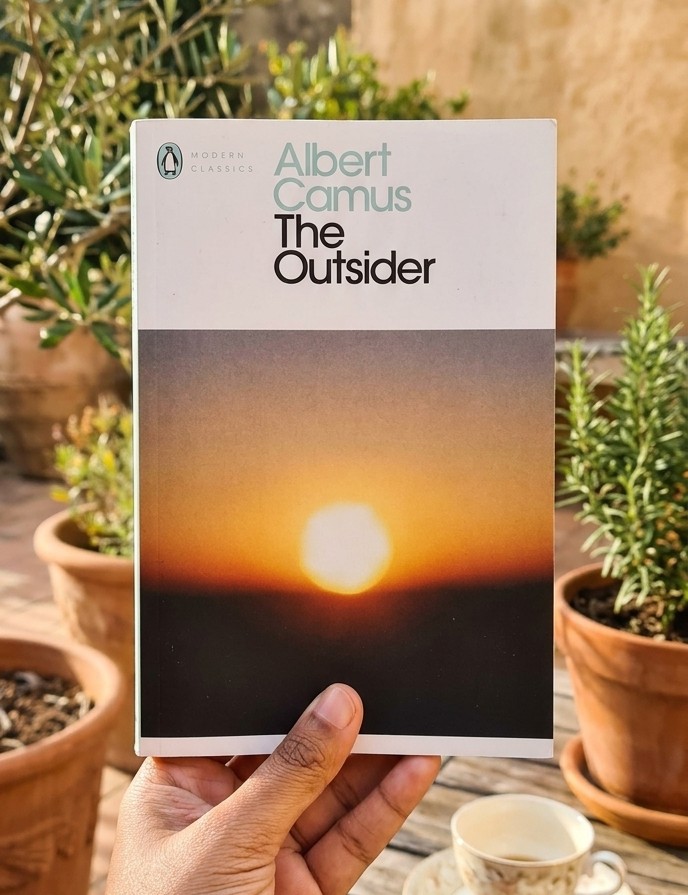
Breaking a Reading Slump with an 8-Decade-Old Classic
There are moments as a reader when nothing seems interesting enough to pick up. Every book feels slow, predictable, or simply not worth the effort. That was exactly the phase I found myself in, until a reading buddy suggested The Outsider by Albert Camus.
I went into it expecting a quick, fast-paced read to escape the slump. What I found instead was a deeply unsettling and thought-provoking experience.
Written in 1942 and read in 2026, this novel has travelled across nearly 8 decades, yet its emotional and philosophical weight feels strikingly relevant even today. It quietly reminds us that some stories do not age, they evolve with the reader.
Meursault: A Man Detached from Emotion
At the center of the story is Meursault, a character who challenges everything we associate with human emotion.
He does not grieve his mother’s death.
He does not express guilt.
He does not react the way society expects him to.
Instead, he exists in a state of quiet detachment.
He attends his mother’s funeral at the old-age home where she lived, without shedding a tear. Soon after, he returns to work, spends time with his girlfriend Marie, and even goes to the movies. For him, life continues as usual, untouched by what others would consider a deeply emotional event.
This emotional distance is not just unusual, it is unsettling. It forces the reader to question whether emotion is something we genuinely feel, or something we perform for society.
Two Halves, One Transformation
The novel is structured in two distinct parts, each shifting the tone and direction of the narrative.
The first part revolves around Meursault’s everyday life, particularly following his mother’s death. What stands out here is not the event itself, but his reaction to it, or rather, the lack of it. His life continues with an almost disturbing sense of normalcy.
The second part moves into the courtroom, marking a sharp turning point. After committing a crime almost unknowingly, Meursault is arrested and put on trial.
However, the trial quickly becomes something more than a legal proceeding.
It transforms into a moral examination of his character.
A Trial Beyond Crime
In court, Meursault is judged not only for his actions but for who he is.
His emotional indifference at his mother’s funeral becomes a key point of accusation. His silence is interpreted as coldness. His honesty is mistaken for a lack of remorse.
Even those around him are drawn into this judgment.
Marie, his girlfriend.
Raymond, his friend.
The old-age home director.
All are brought into the courtroom, not merely to testify about the incident, but to define Meursault’s personality in the eyes of society.
This shift makes the novel less about crime and more about conformity. It raises an unsettling question: are we judged more for what we do, or for how we appear while doing it?
Life Inside Prison: Stillness and Realization
Following his arrest, Meursault’s life inside prison becomes repetitive and stripped of meaning.
Days blur into one another.
He sleeps, waits, and observes.
Time slows down, almost painfully.
Yet within this stillness, something begins to change.
He starts reflecting, not with regret or fear, but with a quiet clarity. His thoughts move toward the inevitability of death and the absurd nature of existence. There is no dramatic transformation, but rather a subtle acceptance of reality as it is.
This internal shift is where the philosophical depth of the novel truly emerges.
Questions That Stay
As the narrative progresses, it leaves behind a trail of questions rather than answers:
- Is silence a form of guilt?
- Can indifference be more unsettling than action?
- What does it mean to live authentically in a world that expects emotional performance?
This is not just a story to be read. It is a story that quietly confronts the reader.
Sometimes, not reacting feels harmless.
But what if that silence becomes louder than any action?
The Outsider is a brief yet powerful read that invites deep reflection.
It is not emotionally loud, but its silence is striking. It does not guide you toward a conclusion, but instead leaves you questioning your own responses to life and the people around you.
Though small in size, this book carries a weight that stays far beyond its pages. It is the kind of read that gently unsettles you, urging you to pause and reflect.
About the Author: Albert Camus
Albert Camus was a French philosopher, novelist, and journalist, widely associated with the philosophy of existentialism and the concept of the absurd.
Born in Algeria in 1913, Camus explored themes of meaning, morality, and human existence through his works. His writing often reflects the tension between the human desire for purpose and the indifferent nature of the universe.
The Outsider remains one of his most celebrated works, offering a powerful introduction to his philosophical ideas through a simple yet deeply layered narrative.
In 1957, Camus was awarded the Nobel Prize in Literature for his significant contribution to modern thought and literature.
 Bookish Brewing
Leave a comment