
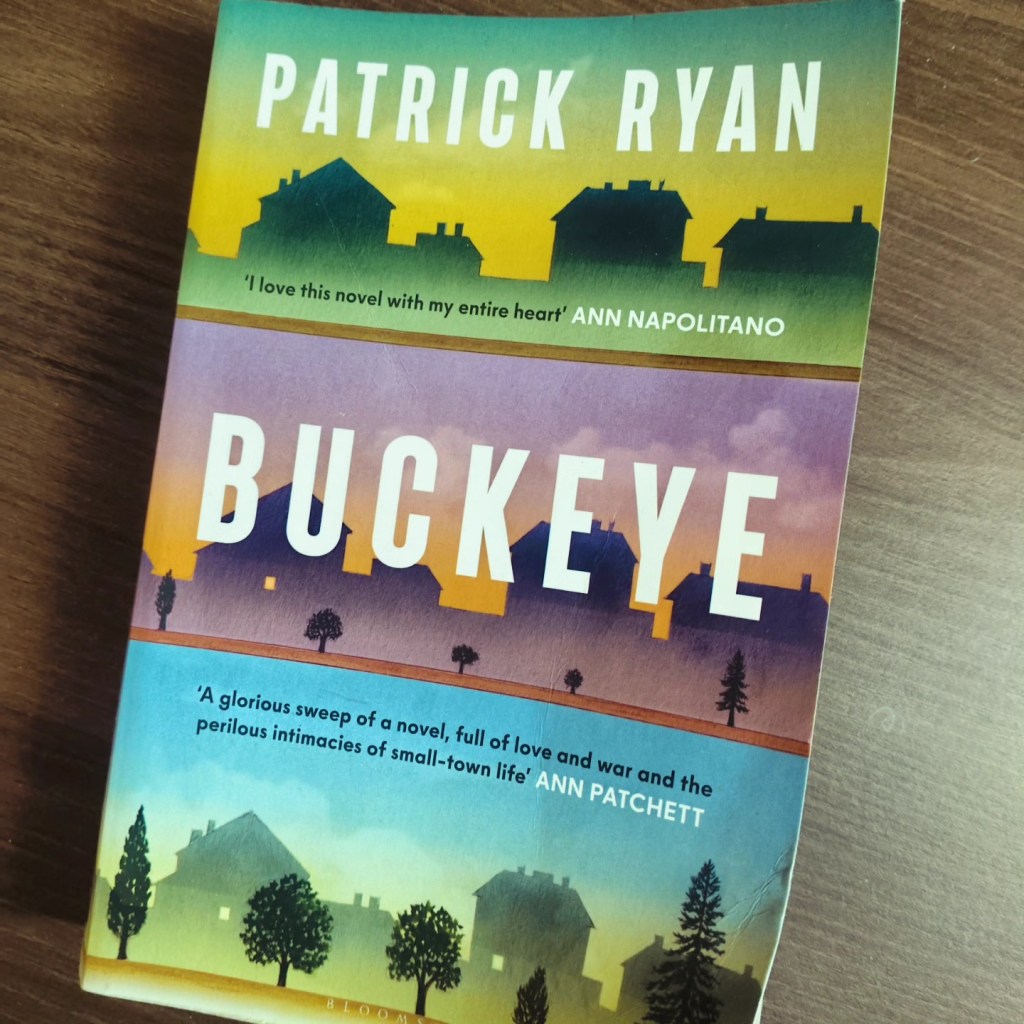
Patrick Ryan’s Buckeye is the kind of novel that slips into your heart quietly and settles there long after you’ve turned the last page. Set in the small fictional town of Bonhomie, Ohio, this sweeping, multi-decade story unravels the delicate threads of family, longing, war, and the secrets that bind—and sometimes break—ordinary people. What makes Buckeye unforgettable is not the scale of its plot, but the intimacy with which Ryan captures the hidden storms behind seemingly simple lives.
The novel begins on May 8, 1945, the day World War II ends. Bonhomie celebrates with the rest of the world, but for the characters at the center of this story, the end of war marks the beginning of a different kind of internal battle. Cal Jenkins—one of the novel’s emotional anchors—is a man who never went to war due to a physical condition. While other men return home as heroes, Cal carries the quiet ache of someone who feels he failed a test he never chose to take. His wife, Becky, adds a layer of mystique to the story: she has the uncanny ability to see the dead and helps grieving families communicate with their loved ones. It’s an unusual gift for a town that loves normalcy, yet Becky’s compassion softens the strangeness of her role.
On the same day that peace is declared, another family’s story begins to shift. Margaret Salt, whose husband Felix is away serving on a Navy cargo ship, crosses paths with Cal in a moment that feels small yet lingers like a bruise. Ryan doesn’t sensationalize this encounter; instead, he shows how one fleeting moment between two lonely people can spill into decades of silence, guilt, and unspoken memory. That single moment becomes the emotional fault line on which the story quietly trembles.
As the years roll through the 1940s, ’50s, ’60s, ’70s, and beyond, Buckeye deepens into a story about how generations inherit decisions they never made. Children grow up carrying echoes of secrets they don’t fully understand. Marriages stretch, fray, and mend—sometimes in unexpected ways. Ryan paints all of this with a gentle brush, never rushing his characters toward transformation but letting them evolve the way real people do: slowly, subtly, almost imperceptibly.
One of the most striking strengths of the novel is its attention to the tiny rituals of small-town American life. There are kitchen conversations, long car rides, silent dinners filled with emotion, gas station stops, and hardware-store errands that somehow carry more meaning than the large plot points. Ryan uses these everyday moments to explore how people cope—with desire, with disappointment, with hope, with the lingering shadows of war. The ordinary becomes the lens through which he reveals the extraordinary.
Thematically, Buckeye is rich and layered. It explores:
The invisible aftermath of war
The men return home changed; the women who stayed behind carry their own emotional wounds. The novel shows how war reshapes a community long after the bullets stop.
Desire, betrayal, and marriage
Ryan is unflinching in his portrayal of relationships—messy, flawed, deeply human. The novel refuses to idealize love; instead, it examines the longing for connection, the weight of mistakes, and the complexity of forgiveness.
Secrets and generational echoes
A single choice reverberates through decades, affecting people who had no part in it. Ryan shows how silence can sometimes shape a family more than truth.
The slow evolution of small-town America
From shifting gender roles to cultural turbulence, Bonhomie changes with the times, even when its residents cling to familiarity. The town becomes a character in itself, both comforting and confining.
What makes Buckeye so compelling is Ryan’s prose—clean, restrained, and emotionally precise. He doesn’t depend on dramatic twists; instead, he builds tension through everyday moments and the emotions people do not voice. The storytelling feels like sitting on a porch on a quiet evening with someone who knows the town’s history too well and finally decides to share it.
As a reader, you don’t just observe these characters—you live with them. You feel Cal’s quiet yearning, Becky’s burdened intuition, Margaret’s unresolved ache, and Felix’s absence that becomes its own presence. These characters are not saints or villains; they are people shaped by circumstance, trapped by time, and softened by love. By the end of the novel, they feel like people you once knew or perhaps even like fragments of yourself.
One of the most beautiful things about Buckeye is how it honors the idea that not all stories need to be loud. Some stories are built on the gentle accumulation of moments, heartbreaks, reconciliations, and the steady passing of years. Ryan reminds us that life rarely offers dramatic conclusions—just small revelations that feel monumental in the quiet of everyday life.
For readers who love multigenerational family dramas, subtle emotional tension, historical backdrops, and character-driven storytelling, Buckeye is a must-read. It’s the kind of novel that leaves you reflective, touched, and perhaps more attentive to the quiet lives unfolding around you.
About the Author
Patrick Ryan is an American novelist and short-story writer known for his emotionally resonant storytelling and sharp observational style. Born in 1965 in Washington, D.C., and raised in Florida, Ryan holds an MFA from Bowling Green State University. Before Buckeye, he published acclaimed short-story collections such as The Dream Life of Astronauts and Send Me. His work has appeared in The Best American Short Stories, and he has served as associate editor of Granta and editor of the literary magazine One Story. With Buckeye, Ryan makes a powerful leap into expansive, multigenerational fiction, showcasing his gift for nuance, empathy, and timeless human insight.
 Bookish Brewing
Leave a comment