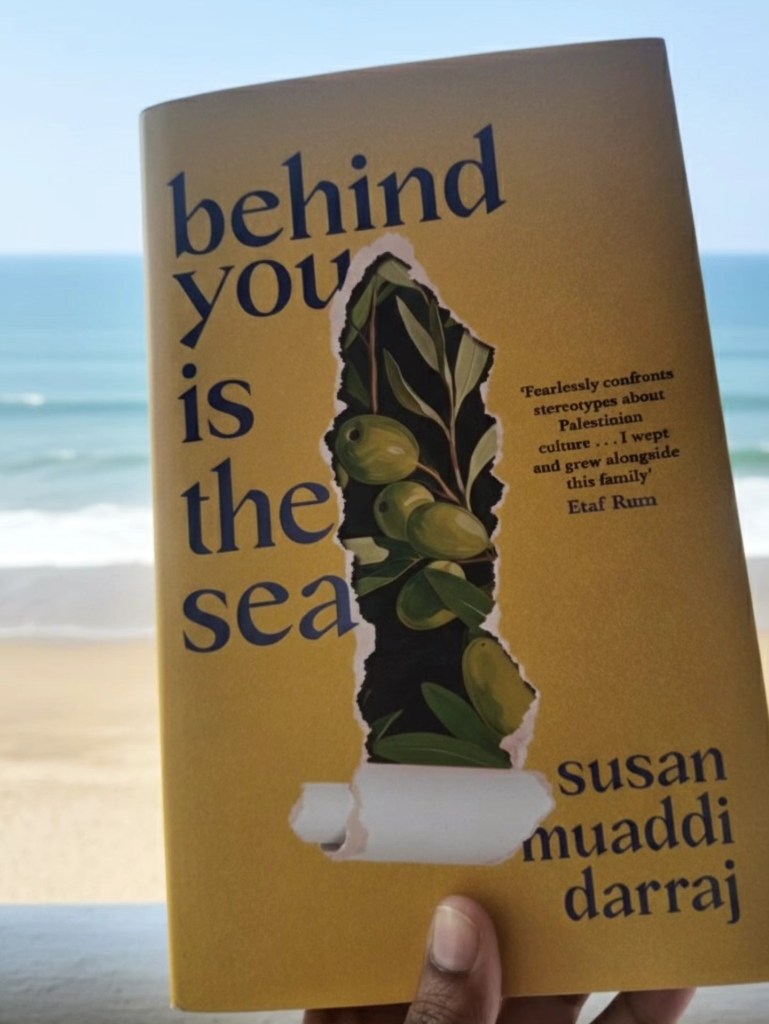
Susan Muaddi Darraj’s Behind You Is the Sea is a novel that feels both intimate and expansive, bringing together the voices of Palestinian American families living in Baltimore. Instead of following a single character, the book is shaped as a mosaic of interconnected chapters, each focusing on a different individual or family within the community. This structure allows the author to present multiple perspectives on the immigrant experience, showing both the struggles of the first generation and the identity conflicts of the second generation. The story reflects the complexity of real life, fragmented in form but unified in its emotional depth.
The backdrop of the novel is divided between Baltimore and Palestine. Baltimore is the immediate setting, where immigrant families attempt to balance American realities with cultural expectations, generational gaps, and differences in social class. Yet Palestine is never absent. It exists in memory, tradition, and longing. It surfaces in family rituals, in generational conflicts, and in the yearning to remain connected to heritage. A central moment in the book involves a son taking his father’s body back to Palestine for burial, which becomes a powerful symbol of duty and belonging. The novel’s title, inspired by the words of Tariq ibn Ziyad, “Behind you is the sea, before you the enemy,” captures this condition of displacement and courage. For the characters, there is no turning back, only the challenge of moving forward while carrying the past with them.
The characters are vibrant and multifaceted, each contributing to the novel’s depth. Marcus Salameh, a Baltimore police detective, struggles under the weight of his father’s expectations. His journey to fulfill his father’s final wish reflects themes of identity, reconciliation, and responsibility. Layla Marwan, a young high school student, embodies the struggle of growing up between cultures. She faces stereotypes and learns to define her own identity within a society that does not always accept her. Maysoon Baladi, from a working-class family, is employed by the wealthy Ammars, offering a sharp view of class tensions even within the Palestinian American community. These contrasting experiences reveal that there is no single story of immigration. Each perspective complicates and enriches the overall picture of Palestinian American life.
The writing style is direct, emotional, and layered with detail. Susan Muaddi Darraj addresses subjects such as domestic violence, gender expectations, mental health, and cultural shame with honesty and sensitivity. Her prose does not reduce her characters to struggles alone. Instead, she highlights moments of humor, love, and resilience that balance the hardships. The shifts in narrative voice, sometimes first person and sometimes third person, may surprise readers at first, but they become an important strength of the book. These shifts allow each character to speak with an authentic voice, making the novel feel like a living conversation among different generations and social groups.
What makes the novel especially compelling is the way Darraj has engaged herself in the writing process. She worked on the book for years, beginning with the story of one character and slowly expanding the community around him. That patience is evident in the care she gives to each chapter. Every character feels distinct, with their own emotions, conflicts, and values. The novel challenges stereotypes about Palestinians and Arabs in America, showing lives that are rich, complicated, and full of contradictions. By drawing on her own background and cultural knowledge, Darraj creates a story that feels deeply authentic.
The pacing is shaped by the book’s structure as interconnected stories. Some chapters are intense and emotionally heavy, while others capture quieter, everyday moments. This rhythm might not satisfy readers who prefer a single, linear storyline, but it rewards those who embrace layered storytelling. The final chapter, focused on returning a body to Palestine, ties together the themes of homeland, family duty, and memory, leaving a lasting impression on the reader.
One of the greatest strengths of Behind You Is the Sea is its refusal to present a simple version of Palestinian American life. The novel acknowledges generational conflicts, class differences, and the difficulty of holding on to cultural identity in a new land. Yet it also celebrates resilience, humor, and love. The older generation carries the weight of exile and loss, while their children and grandchildren attempt to build new lives in America. These tensions and hopes make the novel relatable to anyone who has experienced life between cultures.
For readers, the book serves both as a window and a mirror. It provides insight for those who may not know much about Palestinian American communities, while also offering representation for those who share the same experiences. The themes of belonging, identity, and survival resonate across cultural boundaries, making it a novel that will appeal to readers of diaspora literature, immigrant stories, and literary fiction centered on characters rather than plot.
In conclusion, Behind You Is the Sea is a remarkable debut that blends storytelling with cultural depth and emotional truth. Susan Muaddi Darraj has created a work that honors the complexities of identity and migration while offering readers characters they can recognize and care for. It is a book that will remain with its readers long after they finish it, a contribution not only to Palestinian American literature but also to the wider landscape of contemporary fiction.
About the Author
Susan Muaddi Darraj is an award-winning Palestinian American writer and professor. She has published short story collections, children’s books, and essays, and she is known for her dedication to amplifying underrepresented voices. Behind You Is the Sea is her first novel, and it reflects her commitment to telling stories that challenge stereotypes while celebrating cultural identity and resilience.
 Bookish Brewing
Leave a comment